
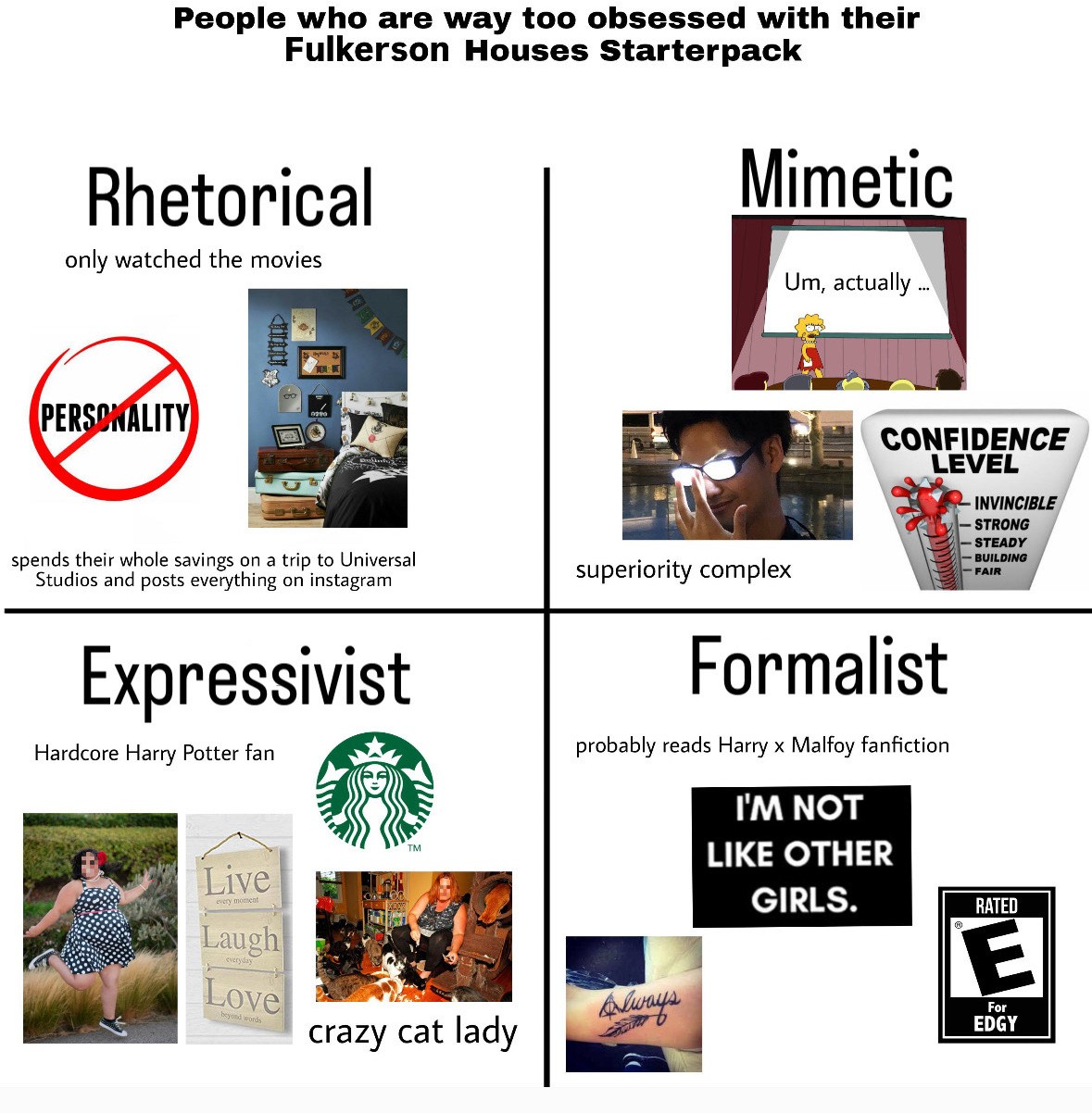
Once upon a time, when I was just a Tiny Jordan, I naively thought writing was about, well, writing. I put words on a page. Silly me. Turns out, writing in academia is a battlefield, and every professor—whether they teach English, psychology, history or biology—has their own underlying philosophy about what makes writing “good.” Think of it like Hogwarts, but for grading essays. Except instead of Gryffindor, Ravenclaw, Hufflepuff and Slytherin, your professor might secretly belong to one of the Four Great Factions of Teaching Writing. Much like Hogwarts, the faction they belong to shapes your entire academic destiny (or at least determines how painful your alleged “easy A” Intro to Lit class will be).
The problem is, unlike Hogwarts, most professors don’t even realize they have been sorted. In fact, composition studies giant Richard Fulkerson pointed out decades ago that many instructors do not consciously think about their teaching philosophies at all. They think they are just teaching “good writing” (whatever that means) without realizing that the way they define “good” comes with serious ideological baggage. They think they’re just teaching “good writing” (whatever that means) without realizing that the way they define “good” comes with some serious ideological baggage. Some of them contradict themselves without even noticing, grading one way but lecturing another, praising one thing while punishing another, creating a classroom where students are left scrambling to decode an unspoken (and sometimes incoherent) philosophy.
This is where Fulkerson’s framework comes in. As a student, you want to survive the battlefield of academic writing, you need to know what type of professor you’re dealing with. As for educators, well, it is going to take some soul searching.
Educators in an Identity Crisis
Here’s the truth that Fulkerson pointed out decades ago: every educator who assigns writing has a philosophy about it. The ones who say they do not just have not thought about it long enough.
Many instructors assume that writing is just a neutral skill—something separate from their discipline that students either do well or don’t. They believe they are simply evaluating ideas, logic or research. In reality, they are enforcing very specific, deeply ingrained values about language, communication and power.
Some educators say they care only about content and not about style, but they still expect a certain level of clarity, structure and professionalism. Others claim to value creativity and original thought, but then take off points for not following rigid disciplinary conventions. Some insist that writing is about evidence and argument, yet reward students who simply mirror the instructor’s own perspective. Then there are those who think they are being neutral by focusing on grammar and correctness—without realizing that what counts as “correct” is shaped by historical, cultural and institutional biases.
Fulkerson’s greatest insight was that teaching writing is never just about writing; it is always about what an instructor believes writing should do. If a professor doesn’t consciously think about what they value in writing, they end up sending mixed signals to students, grading in ways that contradict their own stated expectations.
The result? Frustrated students, inconsistent grading and writing instruction that feels impossible to navigate.
Why Educators Need to Know Their Own Teaching Style
If educators don’t know what they actually value in writing, how can they expect students to understand what’s expected of them? Academic writing is not a one-size-fits-all skill. It varies across disciplines, assignments and individual instructor preferences. Some fields prize concise, objective writing, while others expect nuanced, theoretical analysis. Some assignments call for argumentation, while others emphasize reporting information accurately.
Even within the same discipline, educators often have drastically different expectations. A political science professor, for instance, might prioritize persuasive argumentation, while another wants a rigorous presentation of data with minimal rhetorical flair. A psychology professor might emphasize clarity and structure, while another expects students to incorporate dense theoretical frameworks and discipline-specific jargon.
This is why all educators—no matter what they teach, at any grade level—should start with Fulkerson’s framework. His breakdown of four dominant philosophies of writing helps educators recognize what they actually value, ensuring that their grading aligns with their expectations. If a teacher claims that grammar isn’t their main concern but grades like a Formalist, then students should at least know what’s really being valued. That awareness isn’t just for educators; it’s for students too. Once students know what their educator actually cares about, they can adjust accordingly.
The Four Factions of Teaching Writing (Or, Your Educator’s True Hogwarts House)
Formalist House (The Grammar Gatekeepers)
Think: Slytherin, but their Patronus is a semicolon.
If your educator treats grammar as the supreme ruler of all academic success, you’ve landed in Formalist House. Here, writing is about technical precision, structure and correctness above all else. These are the professors who will mark down an otherwise brilliant paper because you forgot to italicize a book title or because your APA citation was missing a period.
Core Beliefs:
- Good writing = Correct writing.
- Rules matter more than content clarity.
- “Audience” and “purpose” are irrelevant if you use “their” instead of “there.”
What You’ll Experience in Class:
Hell
- Papers returned covered in red ink, correcting every small grammatical error.
- Long discussions about why passive voice is evil.
- A grading rubric that devotes an entire section to comma splices but says nothing about argument strength.
Berlin and Fulkerson Say…
Formalism has been on the decline for decades, but it never truly disappeared. Even today, some professors still believe that good writing is error-free writing, ignoring the fact that a grammatically perfect essay can still be completely incoherent. Berlin would argue that Formalists think they are being neutral, but they are actually reinforcing outdated, exclusionary standards of language.
Your Best Strategy: Proofread like your life depends on it. Use Grammarly, spell check and then bribe a friend to read your essay before submission. Also, never, ever start a sentence with “And.”
Expressivist House (The “Find Your Voice” Educators)
Think: Hufflepuff, but make it existential.
If your educator has ever told you that writing is about self-discovery, congratulations, you’ve entered Expressivist House, where personal voice matters more than rigid structure, and where reflection is just as important as research. These professors want your writing to feel genuine, creative and deeply personal, even in academic contexts.
Core Beliefs:
- Writing is about self-expression, not just structure.
- Personal voice matters more than rigid disciplinary conventions.
- “There are no wrong answers” (except, of course, there are).
What You’ll Experience in Class:
Hippies
- Assignments that ask you to connect course material to your own life experiences.
- A professor who encourages you to “find your authentic voice”…whatever that means.
- Peer review sessions where everyone nervously compliments each other instead of offering real critiques.
Berlin and Fulkerson Say…
Expressivism peaked in the 1970s and then “died”—except it didn’t. It just went underground, and by the 2000s, it had made a comeback. Berlin argues that Expressivism, despite its feel-good messaging, actually reinforces individualism in ways that align perfectly with capitalism—placing the burden of success entirely on the writer rather than the larger system they are writing within. Not cool, man.
Your Best Strategy: Make them feel something. Write about a deeply personal experience and tie it to the course content. Bonus points if you make your professor or teacher cry.
Mimetic House (Writing is Thinking, So Think Better)
Think: Ravenclaw, but obsessed with Toulmin’s Model.
If your educator corrects your argument before they correct your grammar, you’re in Mimetic House, where writing is all about logic, reasoning and intellectual depth. These educators believe that bad writing is just bad thinking and that the best way to improve writing is to develop stronger critical thinking skills.
Core Beliefs:
- Writing is a tool for analyzing, questioning and building knowledge.
- Bad writing isn’t a style problem; it’s a thought problem.
- If your ideas are weak, no amount of fancy prose will save you.
What You’ll Experience in Class:
Defeat
- Educators asking, “But what’s your evidence?” no matter how well you think you explained something.
- Comments on your paper that say, “This claim needs more logical development” instead of correcting the writing itself.
- The strong suspicion that you’re actually in a philosophy class and no one told you.
Berlin and Fulkerson Say…
Mimetic approaches used to be the dominant force in academic writing, but over time, they’ve been replaced by more audience-centered and rhetorical approaches. Berlin would argue that Mimeticists assume that truth is objective and ignore the fact that language itself is shaped by power and ideology. Fulkerson, however, saw Mimeticism as an important corrective to Expressivism, emphasizing analysis over self-reflection.
Your Best Strategy: Make your argument as airtight as possible. Cite studies, anticipate counterarguments and never rely on vibes alone.
Rhetorical House (Writing is Power, and You Better Learn How to Use It)
Think: Gryffindor, but with Foucault on speed dial.
If your educator starts talking about audience awareness and discourse communities, congrats! You’ve entered Rhetorical House, where writing is contextual, strategic and possibly revolutionary. These are the educators who believe that writing is never neutral; it’s always shaped by power, ideology and discourse.
Core Beliefs:
- Good writing is effective writing.
- “Correctness” is relative to audience and situation (cue Formalist rage).
- Writing is power, and power must be examined.
What You’ll Experience in Class:
Fighting (at least one per class; seriously, never met wannabe rhetorician that doesn’t want to fight over something – verbally, of course)[physically, on occasion]. You would expect this from Mimetics, but noooo. You read Everything’s an Argument once, and you suddenly want to take that title to heart…
- Reading ads, political speeches and scientific reports as “texts” that shape public perception.
- Debates about whether rhetoric reinforces oppression (spoiler: yes).
- Feeling like you’re in a sociology class but with more annotated bibliographies.
Berlin and Fulkerson Say…
By the 1990s, rhetorical approaches took over academia like a particularly enthusiastic revolution. By 2005, though, even rhetoric had splintered into argumentation-based, genre-based and academic discourse-focused factions. Berlin championed this approach as the only one truly aware of its own ideological stakes.
Your Best Strategy: Cite Foucault at least once. Whatever you do, never suggest that writing can be neutral—that’s the fastest way to lose points (and get into a physical fight).
May the Odds be Ever in Your Favor
Understanding these factions isn’t just about academic curiosity—it’s survival. Whether you like to admit it or not, you are seen (or seeing) through a specific ideological lens.
Educators, be intentional about what you value in student writing, and make it clear. Your students shouldn’t have to guess whether you prioritize structure over creativity, argument strength over discipline-specific conventions or conciseness over depth. If your grading contradicts what you claim to emphasize, reconsider whether you’re actually supporting students’ learning—or just reinforcing an ideology you have not examined.
Students, pay attention, but don’t just conform—engage. If your professor’s expectations are unclear or seem contradictory, ask questions. If their grading standards do not actually support meaningful learning, push back. Writing is not just about earning points; it is about developing your ability to think, argue and communicate. Educators and students should be working together to make writing a tool for discovery and impact—not just a game to be won.
In academia, we are all a part of this faction war. Ignoring the battle doesn’t make it go away. Join a team, and let the games commence.

Leave a Reply